

Adapts very well to soils with medium to high fertility and requires an annual precipitation of around 1000 mm.
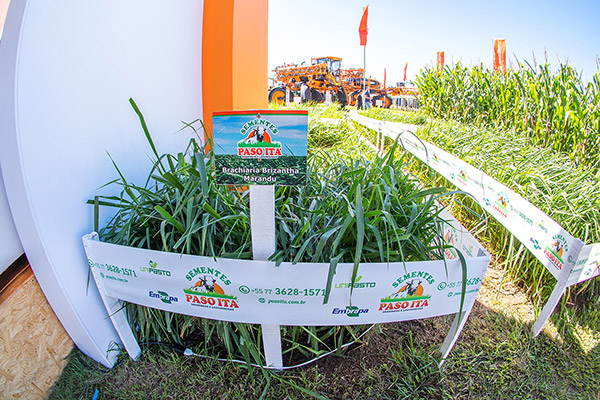
It shows a very deep and vigorous root system, which translates to a good drought tolerance. Also displays good resistance to cold, to shade and to pasture leafhoppers. Does not tolerate waterlogging or flooding.
It is recommended for direct grazing, hay or hay rolls. Greatly intercrops with Stylosanthes type Campo Grande, Callopogonium and Cajanus cajan (pigeon pea).
1) Broadcast
In the normal period, between October and January, use 400 germination rate points per hectare. Then increase to 450 germination rate points.
2) In line
For the normal period, 300 germination rate points per hectare are enough. Afterwards, increase to 350 germination rate points per hectare. In case of intercropping with legumes, reduce quantity of seeds by about 20% to help legume establishment.
Incorporate seeds around 3cm deep with a closed leveling grid after total distribution in the area. As with other species, the best results are obtained by using compactor roller after seeds are incorporated to the soil. In case of intercropping, the recommended operation sequence, once the soil is prepared, is:
Production varying from 15 to 20 tons of dry matter per hectare per year. Its average composition is 9 to 11% brute protein in dry matter. Presents high palatability and around 60% in vitro digestibility.
Formation time revolves from 90 to 120 days after germination, and first pasture must be done after 90 days, with light cattle (thin ox, steer). When animals enter, the pasture displays a height of around 1m, and cattle must be removed when pasture comes to 30 cm above ground. First pasture with light cattle is an essential condition for good pasture formation, because this practice stimulates production of lateral tubers and reduces competition between plants, especially for sunlight.
| Usage Pasture, hay and mulch |
Annual precipitation Above 800mm |
| Drought tolerance Medium |
Dry matter yield 10-20t/ha/year |
| Leafhopper tolerance High |
Crude protein (%DM) 8%-10% |
| Waterlogging tolerance Low |
Formation time 90 days |
| Soil fertility Medium |
Planting depth 2 to 4 cm |
| Soil acidity tolerance Medium |
Growth habit Clumping |
| Altitude Up to 2000m |